


When Yacht Sales Turn Into Competitor Attacks Instead of Honest Comparison
The yacht industry has always been built on passion, innovation, and trust. Buyers make deeply personal decisions based on engineering, safety, performance, and long-term confidence in brands and shipyards. That trust is undermined when brokers or manufacturers resort to misleading claims about competitors instead of focusing on the strengths of their own product.
Recently, a prospective client shared with us an email from a competing catamaran company. Rather than offering objective comparisons of specifications, engineering, or real-world performance, much of the message relied on personal opinion, broad accusations, and attempts to discredit another shipyard through fear and distortion.
Healthy debate is welcome in any serious industry. The issue arises when opinions are presented as facts without evidence, context, or accountability.
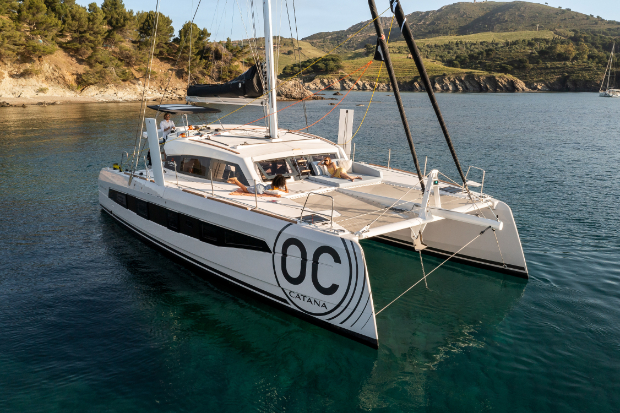
Claims that modern Catana Ocean Class yachts are simply “Balis with daggerboards,” that the company builds “cheap box charter cats,” or that Catana Ocean Class quality is somehow universally inferior are not only inaccurate, but dismissive of the many owners, sailors, and industry professionals with firsthand experience aboard these boats.
Catana has spent decades building offshore performance cruising catamarans recognized worldwide for innovation, composite engineering, structural integrity, and passagemaking capability. Thousands of offshore miles logged by owners around the world speak louder than competitor rhetoric ever could.
What is perhaps most revealing is the need for these kinds of attacks in the first place. Strong brands rarely need to diminish others to justify their value. Exceptional yachts stand on their engineering, owner experience, resale value, and performance at sea, not smear campaigns disguised as “friendly advice.”

Today’s buyers are sophisticated. They sea trial boats, hire surveyors, study construction methods, review owner feedback, and compare real-world data. They understand the difference between subjective opinion and objective reality.
No boat is perfect. Every design reflects a different set of priorities. Some owners prioritize outright speed and racing performance, while others value offshore safety, autonomy, comfort, efficiency, or interior living space. Professionalism requires acknowledging those differences honestly rather than attempting to undermine another brand for commercial gain.
What should concern buyers is not whether a broker prefers one brand over another, that is natural. What should concern them is whether a broker is willing to misrepresent competitors to secure a sale.
If someone is willing to distort facts before a contract is signed, how trustworthy will they be afterward?
The future of the yacht industry should be driven by transparency, engineering, seamanship, and respect, not manufactured controversy and fear-based sales tactics.
At the end of the day, the ocean is the ultimate judge. Not sales emails. We encourage every buyer to do what serious sailors have always done: go sailing, study the boats carefully, speak with real owners, and form conclusions based on firsthand experience rather than emotionally charged competitor narratives.
The truth ultimately reveals itself offshore. But because buyers deserve clear, factual information rather than emotionally charged opinions, we’ve put together the following FAQ to address some of the most common misconceptions and questions surrounding the modern Catana brand.
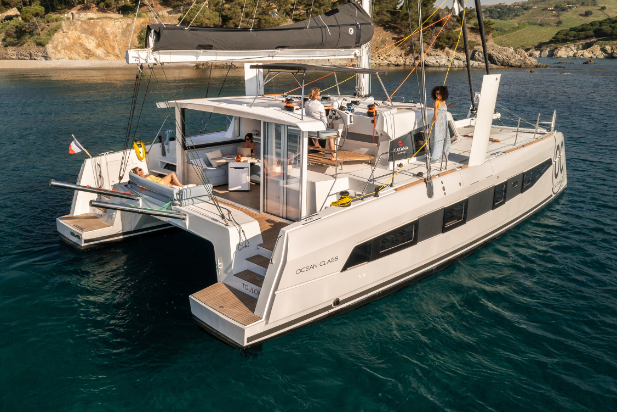
Let’s Address Some of the Assumptions
Is the modern Catana Ocean Class still a true performance cruising catamaran?
Yes.
Catana continues to build high-quality performance cruising catamarans today, and the brand’s core DNA remains very much intact. The Catana OC performance range is still produced in the same Canet-en-Roussillon facility in France, and many of the experienced craftsmen, technicians, and staff who contributed to the brand’s reputation over the years remain with the company today. Far from abandoning its heritage, Catana continues to evolve while maintaining the offshore performance philosophy that established its reputation in the first place.
The Catana performance range was not “revitalized” as a reactionary move against competitors. Production of the line was intentionally paused for a period during which extensive redesign, engineering development, and R&D were undertaken to create a new generation of Catana performance catamarans better aligned with modern offshore sailing expectations and technology.
Are modern Catanas Ocean Class just “Balis with daggerboards”
No.
While Catana and Bali are both part of the Catana Group, they are entirely different product lines built for different owners and use cases.
Bali catamarans prioritize interior volume and social living spaces, while Catana yachts are designed around offshore sailing performance, daggerboards, weight optimization, and passagemaking.
Sharing ownership does not mean the boats are identical in design philosophy or construction.
Has Catana sacrificed quality to reduce costs?
No.
Like every major yacht manufacturer, Catana Group uses modern manufacturing methods and global supply chains to remain competitive and efficient.
That does not inherently mean lower quality.
The Catana OC range continues to utilize advanced composite construction and offshore-focused engineering standards consistent with the brand’s heritage.
Are modern Catana OC catamarans heavy compared to competitors?
Not objectively.
The claim that modern Catana catamarans are “heavy” and no longer performance cruisers does not stand up to objective comparison or real-world results. Let’s compare the Catana 50 OC and the Balance 502 as an example:
- The Catana 50 OC has a published dry weight of approximately 27,000 lbs (13.5 tons), while the Balance 502 ranges between roughly 26,000–30,000 lbs (12.8–14 tons), depending on configuration. In other words, they are in a very similar displacement category.
- Performance ratios also tell an important story. The Catana 50 OC carries a Bruce Number of approximately 1.32, compared to around 1.25 for the Balance 502 — indicating that the Catana remains firmly within the realm of modern performance cruising catamarans.
- Price comparison is equally revealing. The Catana 50 OC is priced around $1.68M, while the Balance 502 approaches approximately $1.9M+, depending on specification.
- Reported owner cruising data further contradicts the narrative. Catana 50 OC owners commonly report cruising averages around 11 knots, while published and owner-reported averages for comparable competitors are often closer to 9 knots. Of course this is third party information and may vary.
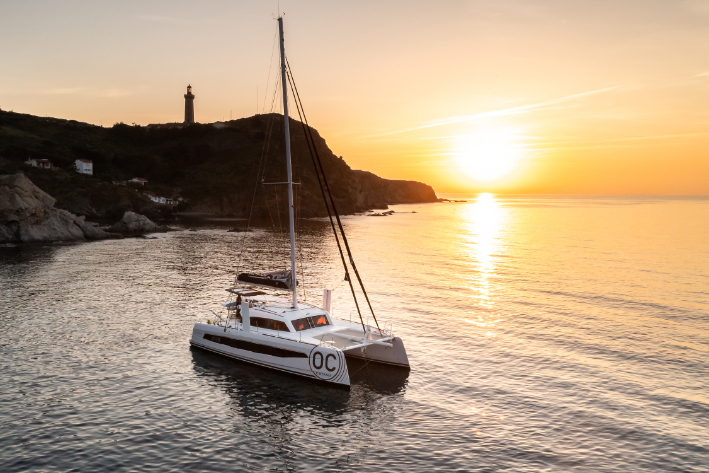
How do modern Catanas perform offshore?
Most importantly, offshore rally performance speaks louder than marketing claims. Several Catana OC models delivered exceptional results in recent ARC rallies:
- In 2024, the Catana 50 “Samurai” won the main ARC Rally crossing the Atlantic in just 16 days, averaging approximately 200 nautical miles per day and regularly surfing above 20 knots.
- “Samurai” also secured 1st place in ARC+ 2024.
- “Piment Rouge,” another Catana 50, finished in 2nd place in 2024 and went on to win the ARC Rally in 2025.
- In 2025, “O’Vive,” a Catana 50, finished 2nd overall.
- “Cooinda,” also a Catana 50, finished 3rd overall just behind a Rapido and an ORC — both widely recognized as ultra-performance catamarans — while recording an impressive 251 nautical miles in 24 hours and maintaining a 10.4-knot average.
These are not the results of “heavy charter cats.” They are the results of capable offshore performance cruising catamarans proving themselves in real ocean conditions against highly respected competitors.
Why is Catana priced below some ultra-performance brands?
Higher pricing does not automatically equate to being in a “different universe” of quality, materials and time to craft. Pricing in the yacht industry reflects many factors, including production philosophy, business model, scale, market positioning, and profit strategy. Another perspective is simply that Catana prices its yachts competitively and responsibly from the outset.
During the COVID-era boom, many manufacturers significantly increased prices in response to extraordinary demand, supply chain disruptions, and market conditions. Catana, however, remained comparatively restrained in its pricing strategy rather than aggressively inflating prices simply because the market allowed it. That approach can also be interpreted as long-term brand responsibility and respect toward customers, rather than an indication of lesser quality or capability.
Since its relaunch, 31 Catana OC 50 models have been sold over the past three years — averaging approximately 10 units annually, precisely in line with the brand’s production and market projections. More broadly, since 1984, Catana has built and delivered more than 650 catamarans worldwide, establishing decades of proven offshore experience and a long-standing reputation within the performance cruising market.
What about customer service?
Every yacht manufacturer has both highly satisfied owners and owners who experience frustrations. That is true across the marine industry.
The most important factor is evaluating current owner experiences, current dealer support, and current company operations — not relying solely on anecdotes from decades ago.
As with any yacht purchase, buyers should speak directly with current owners and conduct their own due diligence.
What should buyers focus on when comparing catamarans?
Every catamaran is designed around different priorities. Some owners prioritize racing performance above all else. Others prioritize offshore safety, comfort, autonomy, efficiency, or interior living space. The right boat depends on the owner’s intended use, sailing style, budget, and long-term goals.
The best approach is always the same:
- Sea trial the boats
- Speak with real owners
- Review construction and engineering details
- Compare real-world offshore experience
- Work with professionals you trust
At the end of the day, the ocean is the ultimate test of any yacht.
Have More Questions About Catana Catamarans? Let's Chat!