


Few design features in modern catamarans have sparked as much discussion as Bali Catamarans’ solid forward deck. When Bali first replaced the traditional trampoline with a rigid foredeck, it challenged decades of accepted multihull design. The result? Strong opinions, lively debate — and ultimately, a fundamental shift in how cruising catamarans are conceived.
So is Bali’s solid foredeck a great feature or a bad idea?
After years of real-world use, owner feedback, and growing industry adoption, the answer is becoming increasingly clear: the solid foredeck is a game-changing innovation — and Bali led the way.
Why Traditional Catamarans Used Trampolines in the First Place
Historically, most catamarans were designed with forward trampolines stretched between the hulls. The logic was simple:
- Trampolines are lightweight
- They allow water to pass through
- They reduce windage
- They were easy to incorporate into early multihull designs
But trampolines also come with limitations. They offer no structural rigidity between the hulls, provide little safety or comfort underway, and serve only one purpose — keeping crew from falling through the bow area.
As cruising catamarans evolved into floating homes designed for families, liveaboards, and long-range cruising, these limitations became increasingly obvious.
Why Bali Chose a Solid Foredeck Instead of a Trampoline
Bali Catamarans didn’t remove the trampoline for styling reasons. The decision was rooted in engineering, structure, safety, and livability.
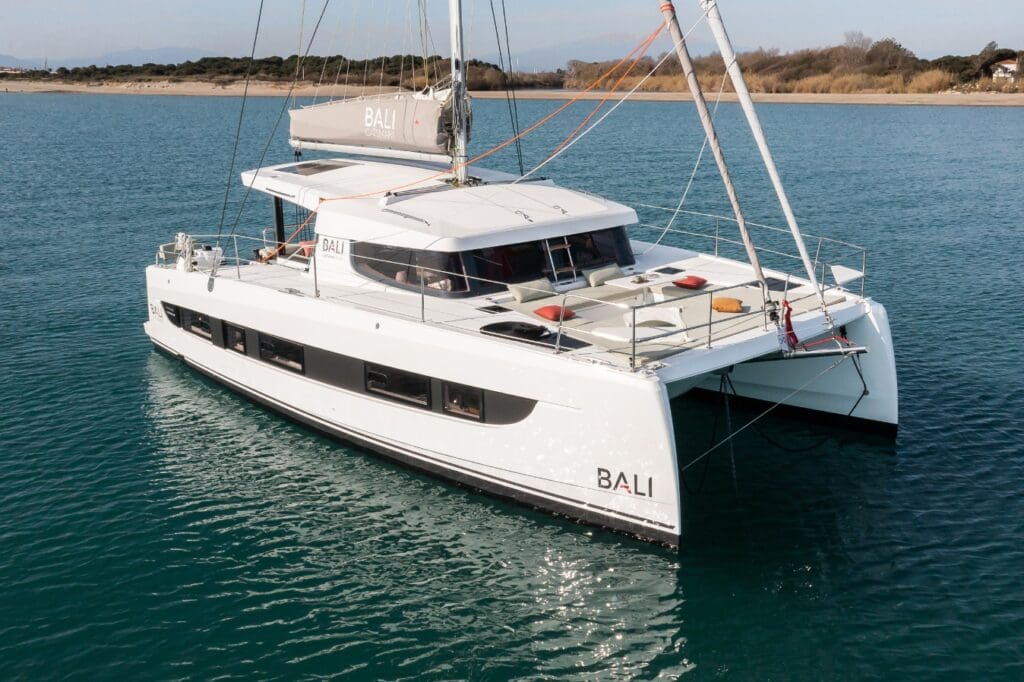
By replacing the trampoline with a rigid, molded forward deck, Bali created a structural bridge between the hulls. This adds stiffness to the platform, reduces torsional flex, and distributes loads more evenly across the boat. In simple terms, the boat works as a more unified structure — an advantage that becomes especially meaningful offshore and over time.
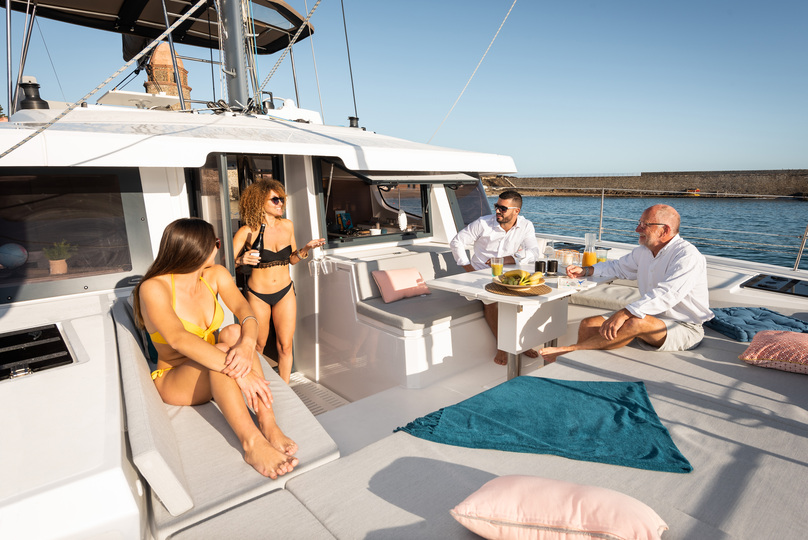
The solid foredeck also allows Bali to create something trampolines never could: a true forward living space. This area isn’t decorative. It’s designed to be used — for lounging, socializing, and enjoying time at anchor or underway.
Structural Benefits: More Than Just Extra Space
One of the most overlooked advantages of the solid foredeck is how it contributes to the overall integrity of the boat.
A rigid deck:
- Improves hull-to-hull connection
- Reduces stress concentrations under load
- Enhances long-term durability
- Supports modern systems integration
Rather than relying solely on crossbeams and nets, Bali’s design spreads loads across a continuous surface. This approach aligns with modern composite engineering and reflects how catamarans are actually used today — heavily loaded, system-rich, and often sailed long distances.
Comfort and Safety in Real-World Cruising
Beyond structure, the solid foredeck dramatically improves comfort and safety.
From a safety standpoint, a rigid surface surrounded by guardrails is easier and safer to move across than flexible netting — especially for families, children, pets, and less experienced sailors. It provides secure footing during sail handling and while moving forward underway.
From a comfort perspective, the solid deck creates a drier experience. While early critics worried about slamming or water retention, modern hull shapes, drainage systems, and weight distribution address these concerns effectively. In practice, many owners report less spray and a more controlled ride in typical cruising conditions.
The Debate — and Why It’s Changing
When Bali first introduced the solid foredeck, skepticism was inevitable. Traditionalists questioned weight, performance, and offshore capability. Some assumed the design was only suitable for charter or coastal use.
But years of real-world operation have reshaped the conversation.
Bali catamarans have crossed oceans, completed long passages, and proven themselves in a wide range of conditions. Owners consistently cite the forward cockpit as one of the most used and loved spaces on board — not a novelty, but a core part of daily life afloat.
As the market has absorbed this reality, the debate has shifted. What was once controversial is now increasingly seen as forward-thinking.
Industry Influence: Others Are Catching On
Perhaps the clearest validation of Bali’s approach is what’s happening across the industry.
More brands are now exploring:
- Enclosed or semi-rigid forward living spaces
- Greater structural integration between hulls
- Designs that prioritize how owners actually live aboard
While implementations vary, the direction is unmistakable.
The industry is recognizing what Bali demonstrated early: the forward deck doesn’t have to be dead space.
Bali didn’t just follow a trend — it created one.
Performance: A Balanced, Modern Cruising Philosophy
It’s important to be clear: Bali catamarans are designed first and foremost as cruising platforms. The solid foredeck reflects that philosophy.
Performance is still very much part of the equation, but not at the expense of comfort, safety, and livability. For the vast majority of owners — couples, families, liveaboards, and charter operators — this balance is exactly what matters most.
The result is a catamaran that feels open, usable, and purpose-built for real life on the water.
The Bottom Line
The solid foredeck is no longer an experiment or a talking point — it’s a proven design evolution.
Bali Catamarans led the industry by questioning a long-standing assumption and replacing it with a smarter, more versatile solution. While debate will always exist in yacht design, the market response, owner experience, and growing influence on other brands all point to the same conclusion:
The solid foredeck isn’t a compromise — it’s a breakthrough.
If you’re evaluating modern cruising catamarans, understanding why Bali pioneered this feature — and why others are now paying attention — is essential.